
26. "No, don't stop looking."
January reading, February new releases, and a Creative Mini chat with Suchitra Sukumar

Dear reader,
My reverse psychology tactic of slowing down the second half of this month wasn’t very successful, unless you count it making each day seem so long and full of things and thoughts that the time felt longer, but then you half-blinked and a week was over, and then another! And now it’s February.
Well, I tried.
I hope you’re all keeping safe and well; looking after your physical, mental, and emotional health as best as possible given your specific circumstances, while you do what you can and must in these tumultuous times, even if this is “just” (no just about it) to show up and care.
Today, I’ve got two publishing updates from January before diving into the reads and recommendations. The issue is on the longer side so you may want to read it in your browser, instead of it getting cut off in your inbox.
A book review of Talking with Boys by Tayyba Kanwal for Tint Journal (January 5, 2026)
I’m glad her publicist reached out to put this debut short story collection (Black Lawrence Press, Immigrant Writing Series, January 2026) across my radar. Tayyba Kanwal is a Pakistani-American writer and Literary Director at Inprint, and, through this interlinked collection of stories, gives a voice to Pakistani and Pakistani-American women navigating a plurality of experiences and a multifaceted existence.
Full review here: https://tintjournal.com/review/a-plurality-of-womens-lives-a-review-of-talking-with-boys-by-tayyba-kanwal
Two snippets:
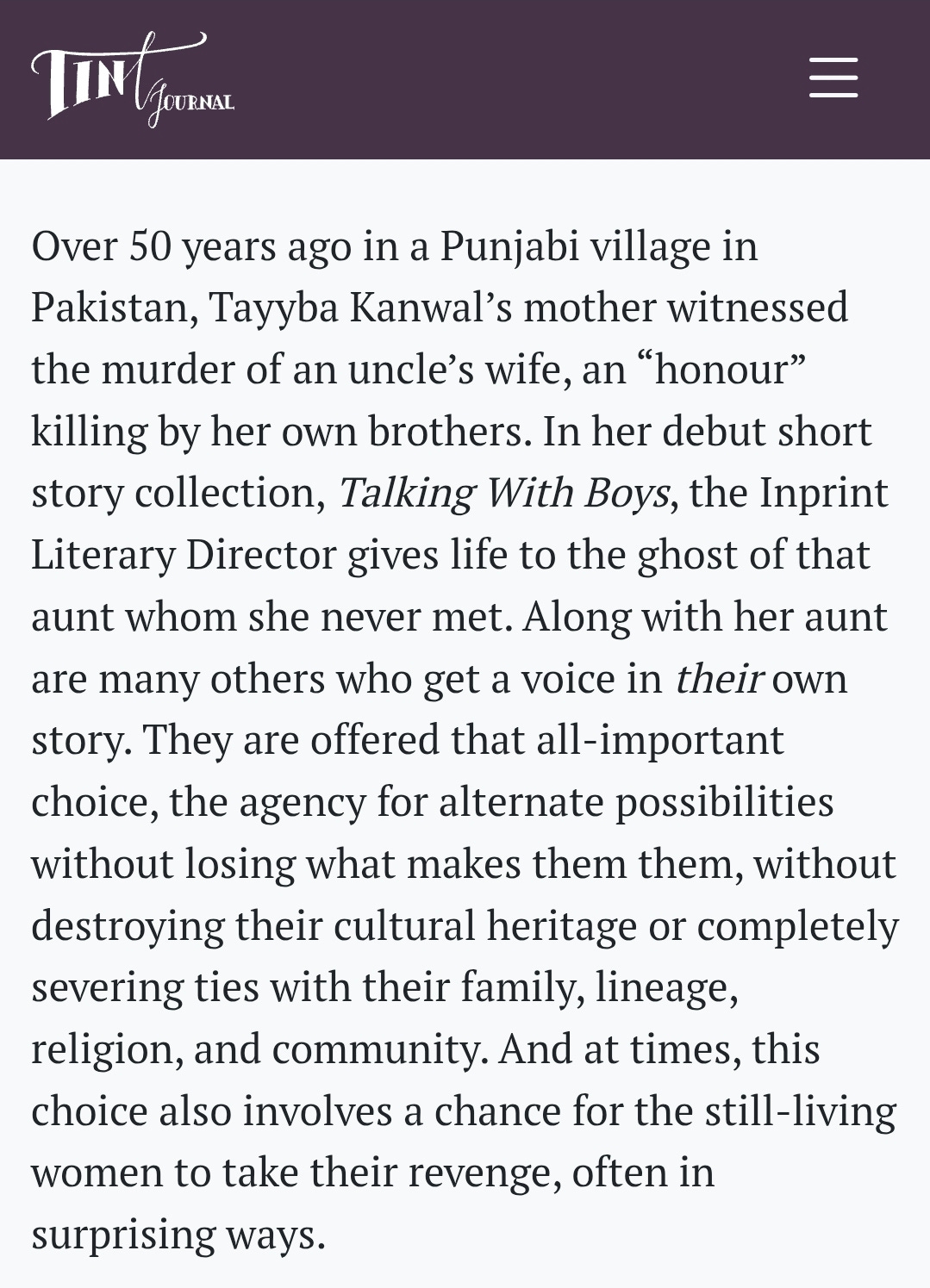
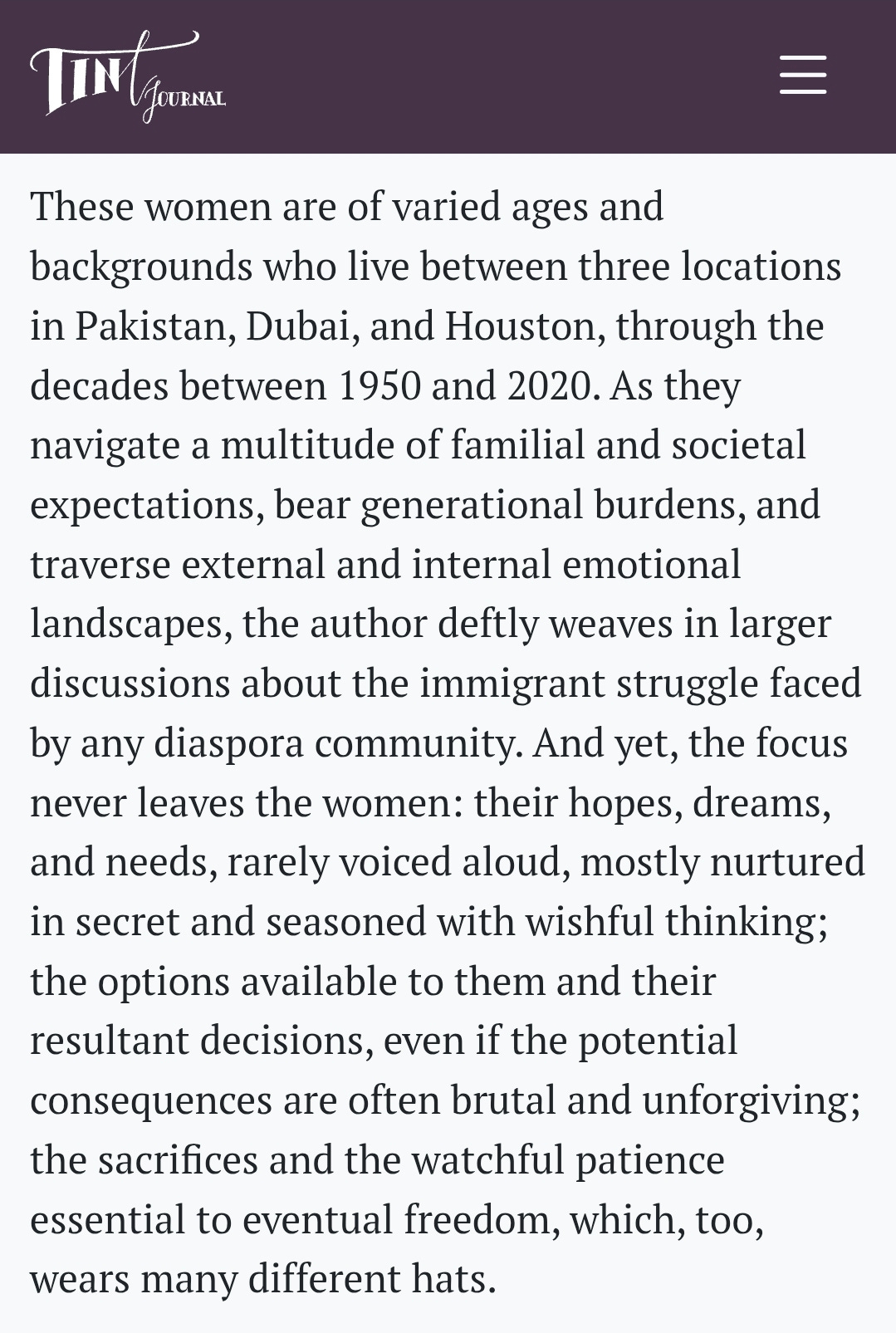
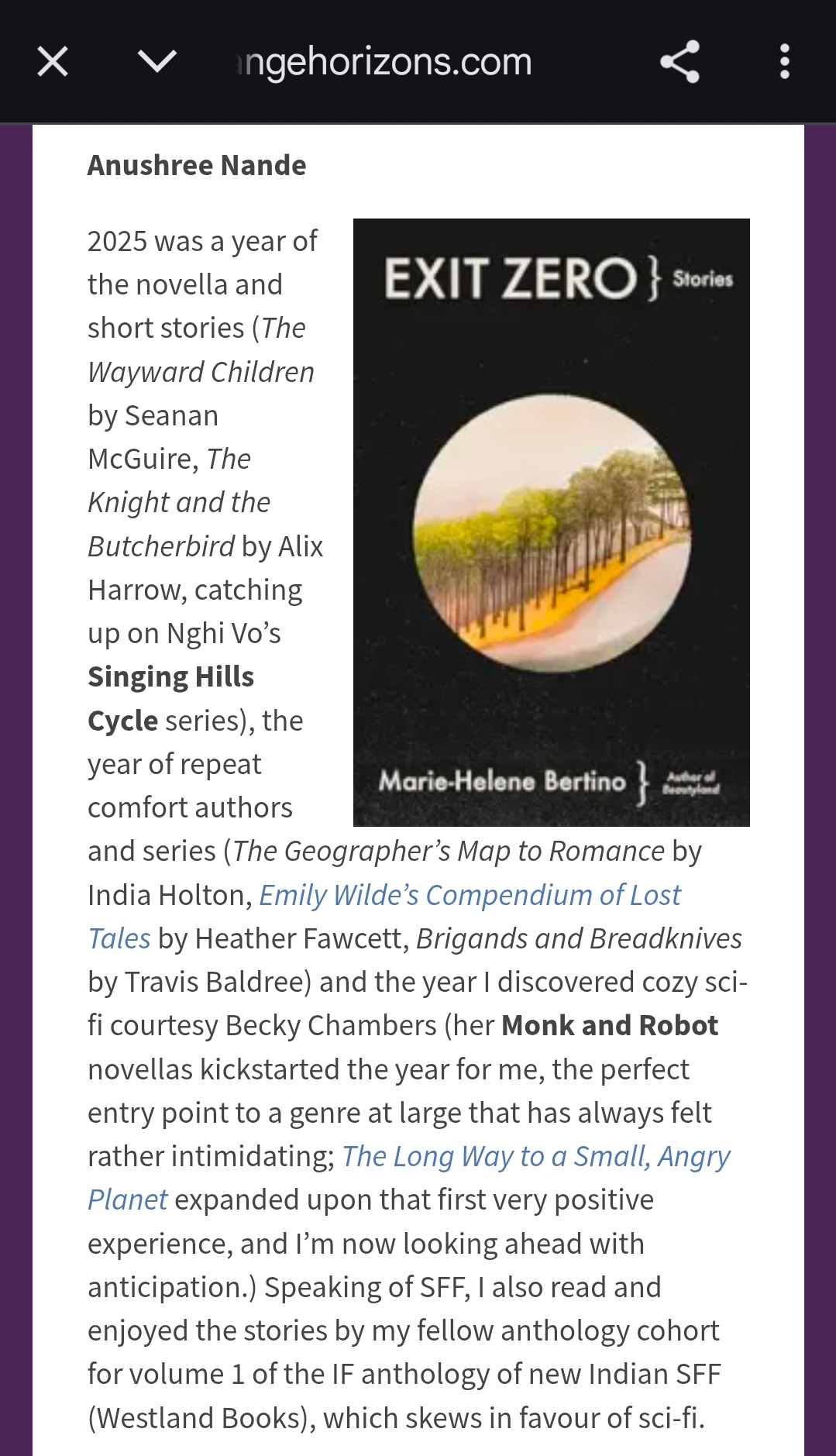
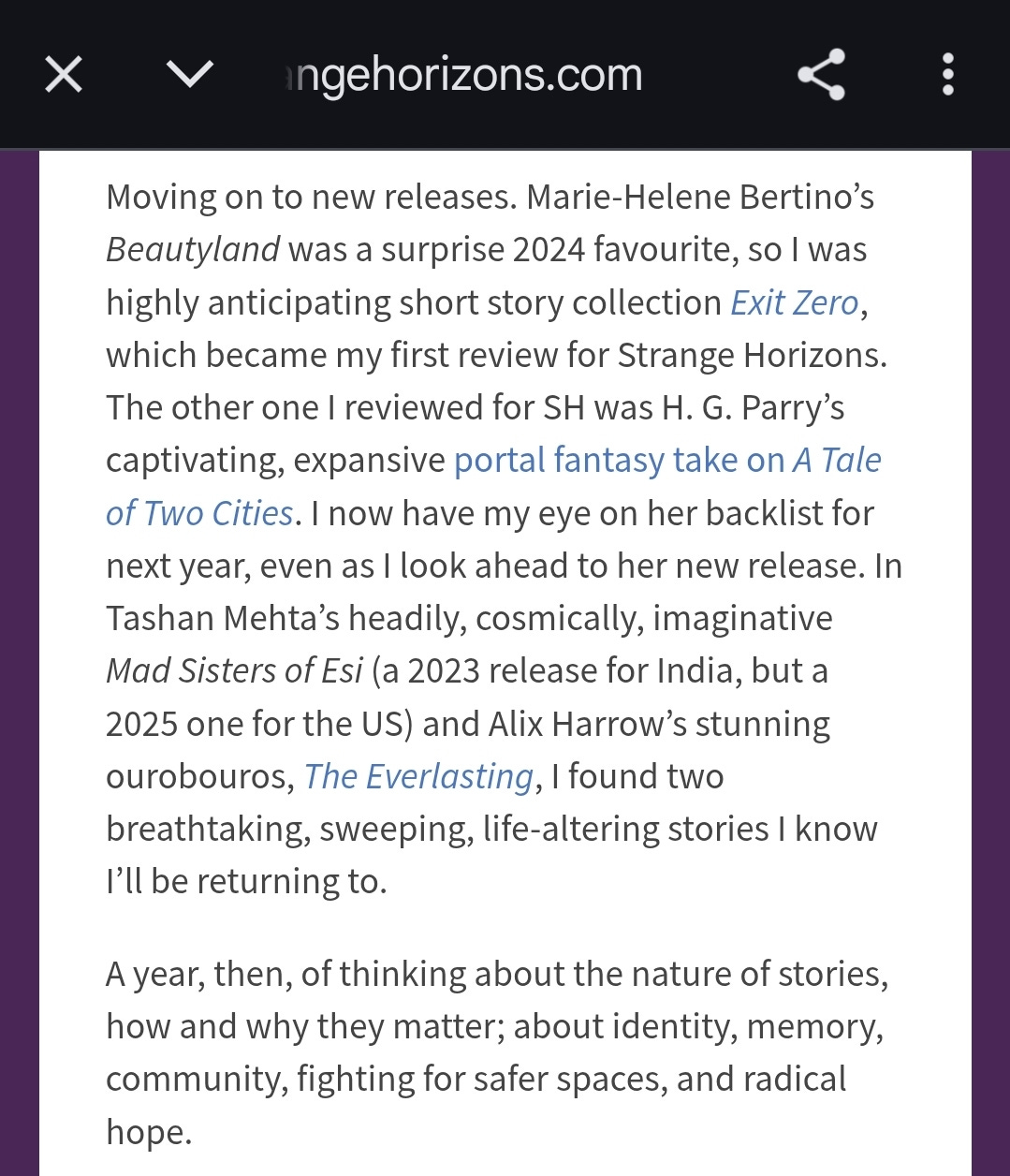
I also got to talk a bit about my reading year for Strange Horizons’ annual Year in Review.
Now onto some of the new releases I’m looking forward to this month. All descriptions are excerpted from the publisher’s blurbs.
New releases: February edition
The Apple and the Pearl by Rym Kechacha
As dawn breaks on All Souls Day, the lingering mists part to unveil an unending vista of serried gravestones. Between them looms a theatre like a haunted house and the sleek iron carapace of a steam train: the Pearl. On board are the cast, orchestra and crew of a travelling ballet company, performing The Apple and the Pearl.
As he stumbles toward the restaurant car the lighting director, Zach, asks the new recruit, Lara, “Have you ever worked in ballet before? Have you had any contact with the supernatural?”
Everyone from the principal ballerina to the first violinist, from the wardrobe mistress to the newest members of the corps de ballet, have committed their lives to the perfection of the show. But every night they must also confront the malevolent glamour of their audience of Fae creatures only too eager to snatch them away into the Otherworld.
Agnes Aubert’s Mystical Cat Shelter by Heather Fawcett
Agnes Aubert leads a meticulously organised life, and she likes it that way. As the proudly type-A manager of a cat rescue charity, she has devoted her life to finding forever homes for stray cats.
Now it’s the shelter that needs a new home. And the only landlord who will rent a space to a cat rescue is a mysterious man called Havelock—who also happens to be the world’s most infamous magician, running an illegal magic shop out of his basement. Havelock is cantankerous and eccentric, but not not handsome, and no, Agnes absolutely does not feel anything but disdain for him. After all, rumors swirl about his shadowy past—including whispers that his dark magic once almost brought about the apocalypse.
Then one day a glamorous magician comes looking for Havelock, putting the magic shop—and the cat shelter—in jeopardy. To save the shelter, Agnes will have to team up with the magician who nearly ended the world . . . and may now be trying to steal her heart.
Havelock is everything Agnes thinks she doesn’t need in her life: chaos, mischief, and a little too much adventure. But as she gets to know him, she discovers that he’s more than the dark magician of legend, and that she may be ready for a little intrigue—and romance—in her life. After all, second chances aren’t just for rescue cats.
Kin by Tayari Jones
A novel about mothers and daughters, friendship and sisterhood, and the complexities of being a woman in the American South, Kin is an exuberant, emotionally rich, unforgettable work from one of the brightest and most irresistible voices in contemporary fiction.
Vernice and Annie, two motherless daughters raised in Honeysuckle, Louisiana, have been best friends and neighbors since earliest childhood but are fated to live starkly different lives. Raised by a fierce aunt determined to give her a stable home in the wake of her mother’s death, Vernice leaves Honeysuckle at eighteen for Spelman College, where she joins a sisterhood of powerfully connected Black women and discovers a world of affluence, manners, aspiration, and inequality. Annie, abandoned by her mother as a child and fixated on the idea of finding her and filling the bottomless hole left by her absence, sets off on a journey that will take her into a world of peril and adversity, as well as love and adventure, culminating in a battle for her life.
Where the False Gods Dwell by Denny S. Bryce
A story inspired by real-life legendary choreographer Katherine Dunham’s groundbreaking expedition into the heart of Caribbean dance culture.
In 1935 Chicago, Othella is an orphaned con artist who needs to escape the city's brutal underworld . . . or else. Vivian Jean is a wealthy wife, student, and anthropologist eager to prove herself professionally and personally. Zinzi is a Jamaican labor union activist determined to bring change to her homeland's plantation system. Thanks to a series of fortunate mishaps and coincidences, all three join Dunham’s voyage to the Maroon village of Accompong in Jamaica’s Cockpit Country—and perhaps discover what they desperately want most.
Through skill and curiosity, Othella becomes a valued member of the expedition, even as she struggles to conceal her past. Zinzi's knowledge of the Cockpit allows the expedition to explore uncharted territory, even as a forbidden love and fierce resistance threaten everything she seeks to protect. As Vivian Jean’s observations help Dunham make unprecedented discoveries, she grapples with her second husband's guilt and accusations. Yet, amidst their private battles, nature presents an even greater challenge.
When a deadly storm bears down on the island, imperiling the women’s missions—and their lives—they must form an unlikely sisterhood. To survive, they will need each other more than anyone or anything they’ve ever needed.
The Forest on the Edge of Time by Jasmin Kirkbride
Recruited by the mysterious Project Kairos to change history and save the future from ecological disaster, Echo and Hazel are transported through time to opposite worlds. Echo works as a healer’s assistant in Ancient Athens, embroiled in dangerous politics and wild philosophy. Hazel is the last human alive, in a laboratory on a polluted island with nothing but tiny robots and an untrustworthy AI for company.
Both women suffer from amnesia, but when they fall asleep, their consciousnesses transcend time and they meet in their dreams. Together, they start to uncover their past—but soon discover the past threatens humanity’s survival.
If Echo and Hazel have a chance of changing the future, they must remember to forget.
What I’m reading
If you read the last issue, you may recall that I was reading Rym Kechacha’s The Apple and the Pearl (also referenced above) and that I was intoxicated by it.
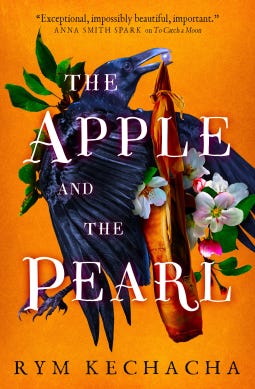
Well, I can report that I very much remained so! This is a super atmospheric character-focused slow burn that is by turns magical, melancholic, and traversing the depths of danger, darkness (external and internal) and the jagged edges of all the emotions humans feel but push down deep.
The POV hops between the main players in the troupe and the production team, which is confusing until you can start to keep everyone, and the various ways in which they connect and intersect, straight. This is a worthwhile endeavour. I read this s l o w, savoured it, until around the 60% mark when the pace suddenly picked up and you felt yourself hurtle toward some inescapable end.
Despite taking place across just one day, we travel across time and lives, and then slip back out of them after tantalising-but-still-fully-realised glimpses. It’s a technique that makes you wish for more POV time with certain characters, but works so well because of the strength of the ensemble and the larger story. I was not expecting the reveal towards the end that, thinking about it, makes perfect sense. It was cleverly done, braiding together everything the narrative had been slowly leading towards. There is a lot of technical ballet stuff in this story (the author’s a trained dancer) that can feel like a lot to try and understand, but after a while I simply focused on the emotions she was drawing on, what she was trying to convey about that world and this art and the cost, passion, inspiration, and fear of it all.
This is the sort of book that you’ll either love or it won’t be your cup of tea. For me, a winner!
After this, I picked up Little Movements by Lauren Morrow, on a, let’s say, kind of informed whim but not really? This ARC had been waiting on my Kindle for months and I hadn’t been able to get to it in time for its release last year, and I remembered that it was also about dance, and so why not now for it to be my next read?
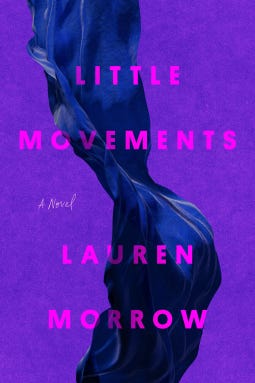
I have to confess that it wasn’t an immediate fit. I even considered DNFing it after finishing reading a few chapters on that first day. But I’m glad I gave it another chance.
So what was it about?
Dance transformed Layla Smart's life as a little girl and she's never since been the same, the passion and hunger to create ever present; though having been told that her body wasn't the right fit for ballet, and despite her Midwestern mother raising her to dream “medium” not big, she is led eventually to choreography and now, in her 30s, following work as a publicist for the Brooklyn Academy of Music, she has been awarded a residency at the esteemed Briar House in Vermont.
Nine months of working with talented dancers of her choice, and the other two resident creatives, a musician and artist, for the showcase performance at the end of it. Even without her doubts about herself and her ability to create meaningful art, Layla has to juggle a long-distance relationship with her husband, managing the dancers, the demands of the Briar House director, the microaggressions and dangers present in a location as predominantly white (not to mention conservative) as Vermont.
Little Movements is a story and a protagonist taking its time to grow on you, but the journey of this young Black woman’s self-discovery as she navigates realising a long-cherished dream (and the sacrifices she must make) is powerfully and vulnerably unputdownable once it gets going. A debut that will have me looking out for more from Morrow!
https://www.instagram.com/reel/C33ZlqJpuoW/?igsh=bjU4emNuejFvZHJn
I’ve been following Jess Janz through her writing on instagram for a few years now, so when I got the chance to early read her debut book, of course I took it. In The Table Where We Meet: Lessons Learned From Dinner With 1000 Strangers, Jess reflects on the leap she took when she first thought up the idea (in her best friend’s hair salon) of gathering strangers around a table and asking them to share who they are beyond their job title (you’re not allowed to mention work at all over the course of the evening), facilitating deeper conversations fuelled with curiosity, courage, and empathy.
If you’ve not read her writing, check it out here: https://www.instagram.com/jessjanz/?hl=en. If you have, you’ll know that it’s tender and hopeful, with an emphasis on the big little things, the quiet things, the seemingly mundane things that are anything but, the numerous ways in which we are all alike. With this book that’s both memoir and essay, we get to sit with Jess for a much longer time than the length of an instagram post, and it’s a delight. Reading it, especially when the world feels so fragmented and pushed to extremes, felt like an exercise in radical hope. I’m yet to process all of my thoughts, so this isn’t the last time you’ll see me write about it, but it was definitely a case of a book finding me at the right time (no matter how many times I witness this magic, it’s still magic).
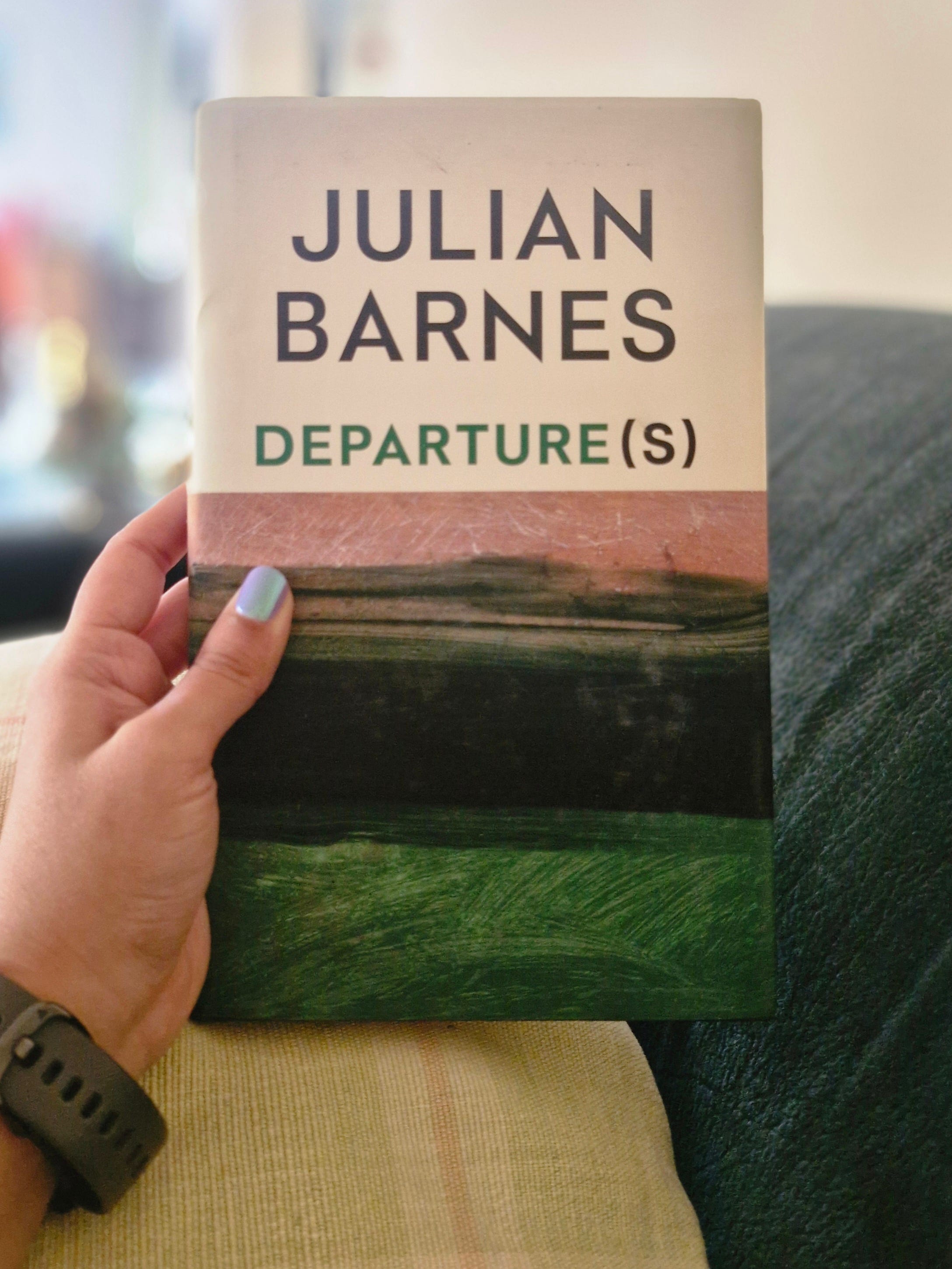
The final book of the month was Julian Barnes’ Departure(s). By the time the next issue of the newsletter’s out, I’ll be able to share the book review I’ve written about it for the Hindu Sunday Magazine. At this point, I have to admit that I’ve only read one other by Barnes and that’s his 2011-Booker-Prize-winning The Sense of an Ending. So why did I pick this? What can I say, the blurb pulled me in. And I guess I was in the right frame of mind for much of this, though some of it did push me into a funk (and I mean the kind of I’ll-never-feel-happy-ever-again-life-is-pointless FUNK, some of which still lingers).
The premise is simple (or not, I’ll get to it). It’s a novel—as the US edition’s title helpfully informs us; it’s literally Departure(s): A Novel. It’s fiction—but, as the jacket copy of the UK edition where the title is only Departure(s) informs us, “that doesn’t mean it’s not true”. The narrator is both Julian Barnes and not him (and yet is also called Julian Barnes and is a writer living in North London, sharing many traits with the author, including a rare blood cancer diagnosis during the pandemic—“incurable but manageable”).
A few pages into the first section, he declares, almost casually, that there were “two things to mention at this stage: there will be a story—or a story within the story—but not just yet; this will be my last book”.
The story in question doesn’t arrive until the second section. Stephen and Jean who may or may not be real, but are definitely pseudonymised because either the author Julian Barnes or the narrator Julian Barnes had promised them he wouldn’t write about them (and yet, here we are, even though both are now long dead).
The blurb tells us that “It is the story of a man called Stephen and a woman called Jean, who fall in love when they are young and again when they’re old. It is the story of an elderly Jack Russell called Jimmy, enviably oblivious to his own mortality”.
But over the course of five sections and 150 pages, it’s about so much more, and yet its central preoccupations thread through, undeniable: memory, fallibility, ageing, illness, love, identity, the limitations of language, the nature of the novelist, and of course death, that ultimate, inevitable, departure without subsequent arrival.
As the titular exits unspool, the fiction, memoir, and essay blur and meld until it’s impossible for the reader to differentiate between fact and figment. If a last hurrah, then one very much on his own terms, at the top of his ability, writing about familiar and long-time concerns.
Which brings me to current reads.
And the answer is nothing beyond my (very) slow Persuasion reread—I’m a little read out at the moment, so let’s see what my first book of February will be!
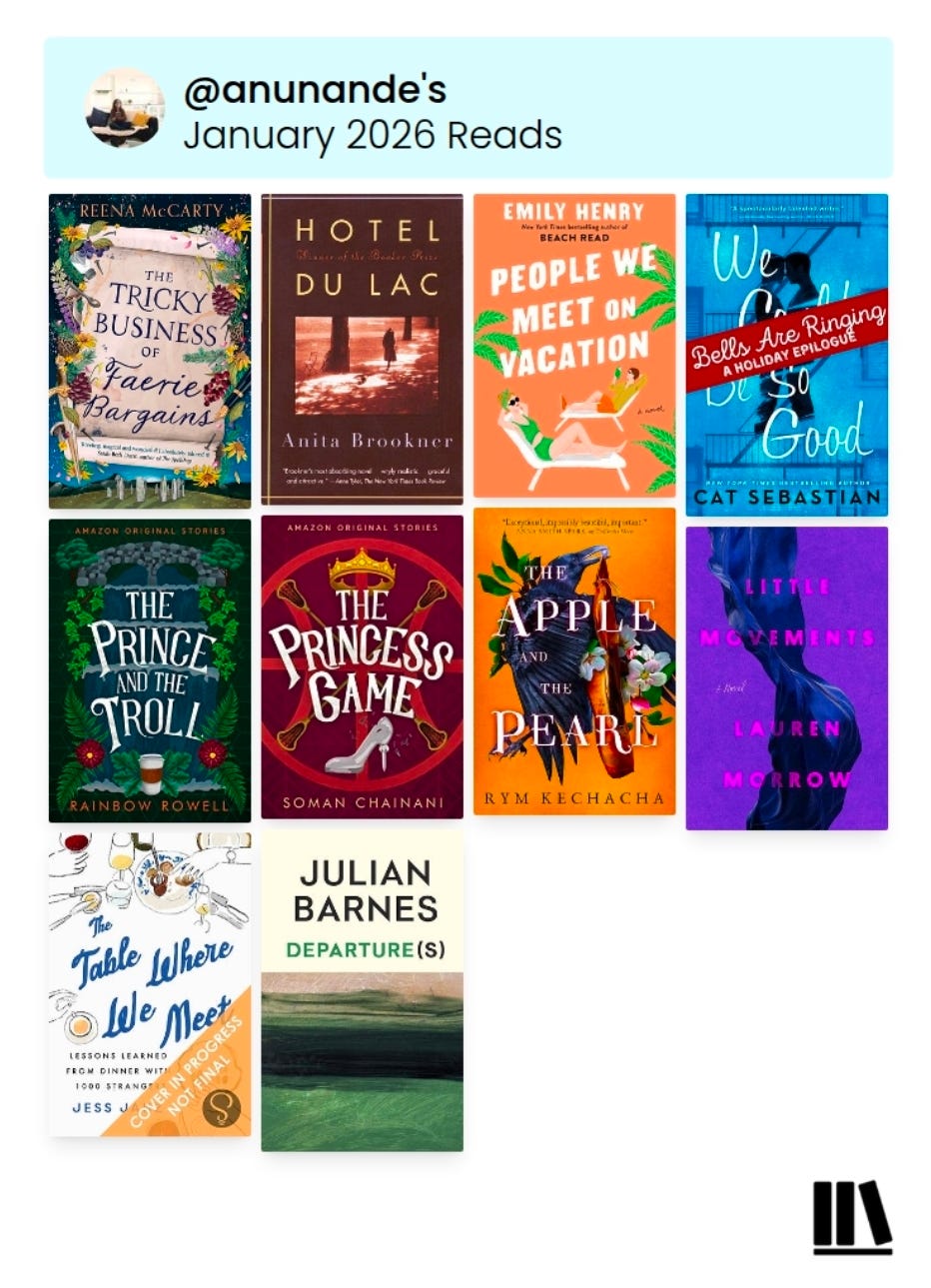
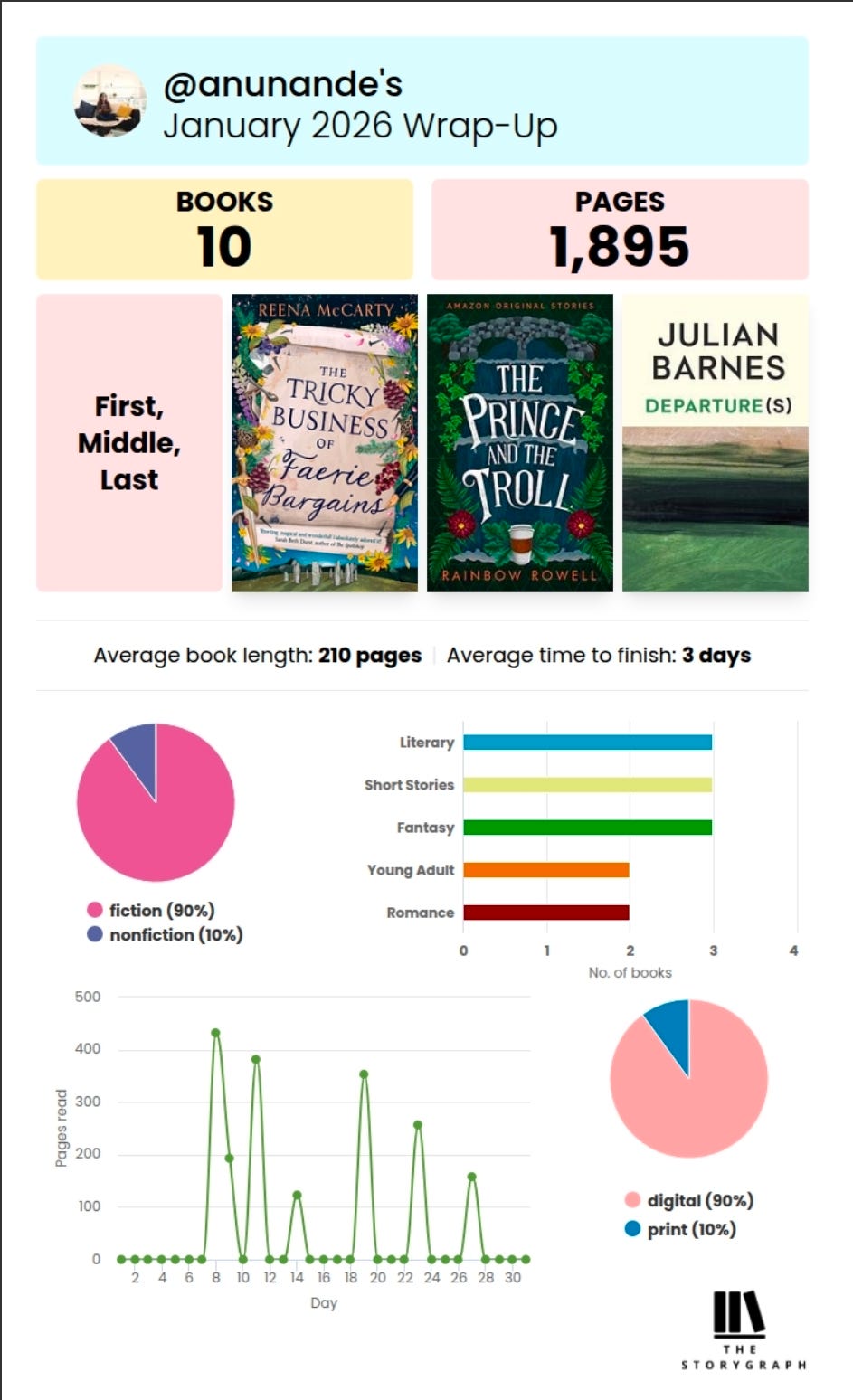
What I read: January 2026 edition
Here is a reading overview of the month gone by. You can find my thoughts on the first half of this month’s reading in the previous newsletter at https://anushreenande.substack.com/i/184746090/what-im-reading
Now onto the promised chat, and with it I’m excited to kick off a mini project: that of interviewing some of my fellow writers from Between Worlds: The IF Anthology of New Indian SFF Vol 1 (edited by Gautam Bhatia).
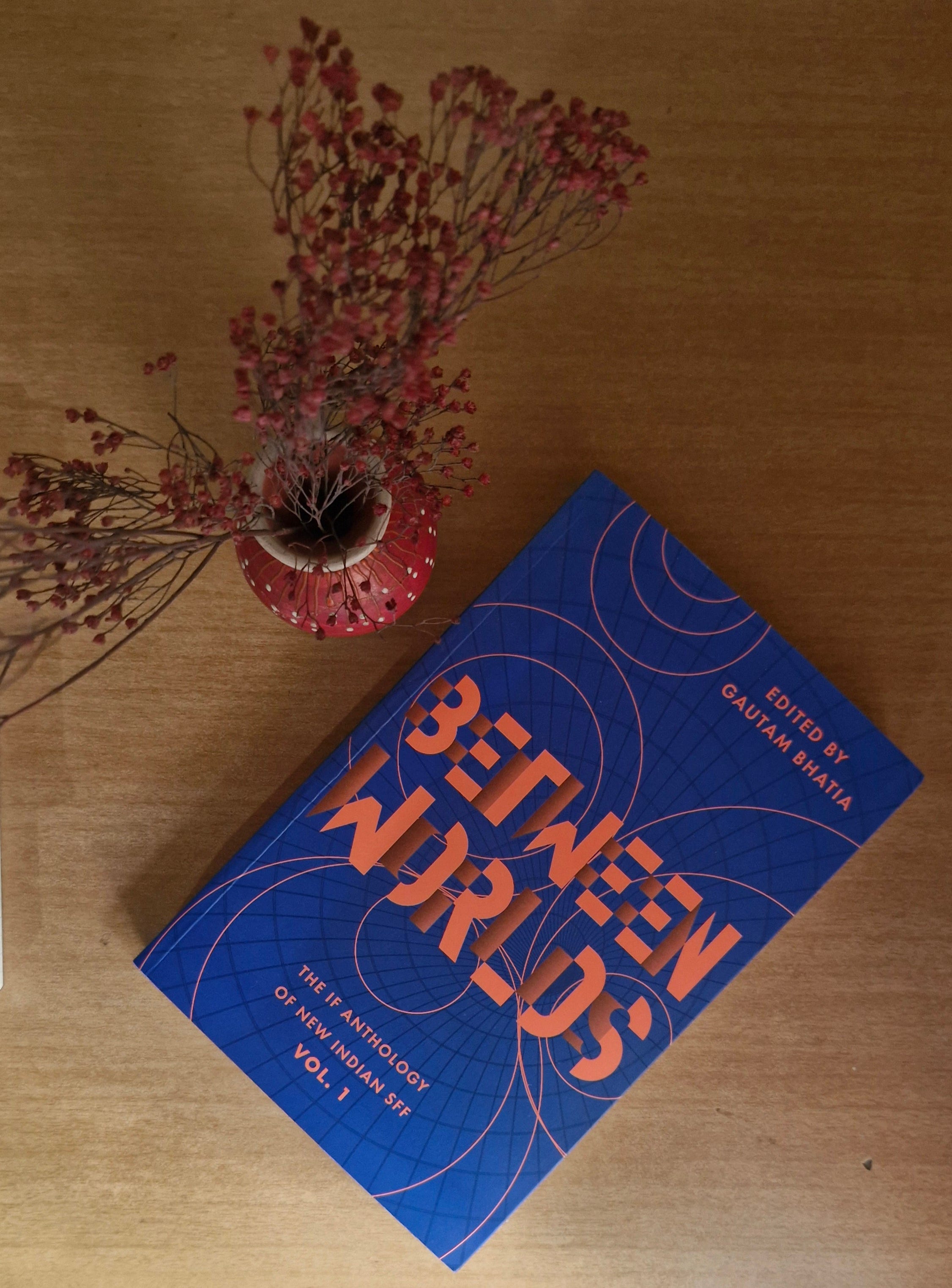
More here: https://anushreenande.substack.com/i/175251402/my-first-professional-story-sale and here: https://anushreenande.substack.com/i/181863606/2025-a-year-of-writing
Creative Mini #2
Welcome Suchitra Sukumar.
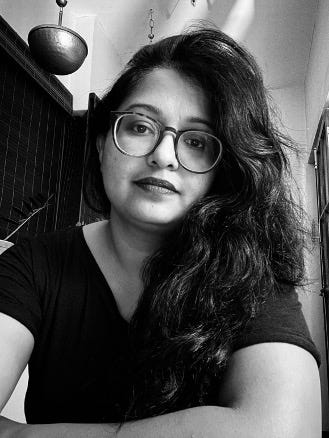
Anu: Can you encapsulate your journey (so far) to the written word? If you have a day job, which, let’s face it, most writers do, how do you balance that with your writing?
Suchitra: I began writing fiction seriously about seven years ago. Since I don’t have any formal training in literature or creative writing, everything had to be learnt from scratch. What I learnt was that the processes I built in my day job don’t always make sense when it comes to writing. For instance, I’d measure progress in writing the way I measure progress at work: keeping an eye on timelines and deadlines as if it were mere arithmetic progression. But, surprise surprise, progress in writing is more like squiggles that run over themselves without logic.
For a long time, my approach to finding balance between work and writing had been a bit of an undirected mad dash with a lot of critical self-parenting. Today, I try to be more reasonable. I measure time-spent writing / editing / thinking, rather than word count. Tomorrow, who knows? Brandon Sanderson says the process evolves as the writer evolves and I’m taking his word for it.
Anu: What do stories mean to you? What draws you towards the stories that you write, tell, read? Why do you write?
Suchitra: Oh, what a scary, and delightful, question to answer! Like most writers, I began by being a keen reader. Stories stayed with me long after I’d read them, words would creep back into my mind in mundane moments and sometimes I’d wonder why an author said what they did. I think I wanted to write for nearly two decades before I admitted it to myself.
Today, I write because telling a story is a sort of proof that I was here, I saw and felt. But I also write because it is less boring than most things I get upto on a daily basis.
Anu: What, according to you, is creativity? How do you keep that spark alive on a regular basis?
Suchitra: I subscribe to the popular notion that everything one does is creative—from work to cooking to conversations, etc. It is a privilege to be able to express oneself. To me, the spark is alive as long as I remember this.
Anu: What are your favourite and not-so-favourite parts about the creative process?
Suchitra: As an incorrigible ‘pantser’, I love free-writing and loathe plotting. But plotting comes only second to editing, which as we all know is like pulling teeth. But… a wise friend once reminded me that the only way out is through, so I humbly submit myself to the torture of editing. Perhaps in another timeline, a stronger version of me even likes it.
Anu: Can you talk a little bit about your anthology story—what it’s about, how it came about, what the process of writing it was like; were there any things that surprised or delighted you during the process, and anything else you’d like to share, really!
Suchitra: In ‘A Rough-edged Confection’, a woman is handed a life-altering gift she never asked for and must contend with it. I was fascinated with the idea of being given a gift one doesn’t want, but the ‘powers that be’ have decided that one needs.
It had many versions before I zeroed in on a domestic setting with a second person POV. In its other avatars, it has been a new religious cult of women with shaved heads, a horror-fantasy, and a psycho-thriller with a protagonist in a coma.
On the second part of your question, almost nothing delighted me in the writing process, haha. I think I was afraid that if I didn’t get it done this time, the story would leave me forever. I’m glad I caught it.
Bonus question:
Anu: What’re you working on at the moment/what’s one thing you’re excited about working on in 2026? (If you want to share.)
Suchitra: I am working on a fantasy novel set in the Sundarbans. It is about a girl who is born into a village full of magicians but has no magical powers herself. It is a secondary world fantasy that borrows heavily from our primary world in terms of setting.
I am currently editing draft 5, which I have promised to myself is the last ever draft of the novel. Wish me luck!
We’re all wishing you luck, Suchitra, and hope to read the novel out in the world someday! Thanks for this chat 😊.
Short author bio
Suchitra is a self-taught writer based in Bangalore, India. She is fiction editor at The Bombay Literary Magazine, and has published short stories in TBLM, Tasavvurnama, and Between Worlds IF Anthology, amongst others. Along with writing short stories, she is currently wrestling with the fifth draft of her first novel and directs intermittent attention to her Substack Everyday Fantastical. She works in a day job to help pay her bills. When she isn’t writing, Suchitra enjoys rambling discussions with her two very wise dogs, and tucks into literary or speculative fiction, depending on where she’s orbiting that day.
You can find Suchitra at instagram | X | substack
Adding a reminder that the Call for Submissions for Volume 2 of the IF anthology of new Indian SFF is still live until March 1, 2026: https://sites.google.com/pratilipi.com/editorsnote-if-anthology/home
From the archives
Quite a few of you have told me that you’re yet to catch up on my last issue from 2025, so here’s me making it easier for you to do just that.
If you’ve enjoyed today’s issue, here’s a few things you can do:
click on the heart to like it
turn this into a conversation by leaving a comment below or dropping me a line via email, even just to say hi—I always love hearing from you 😊
share it with friends and family who might like to read it
Buy me a “coffee” and support my work at https://buymeacoffee.com/anushreenande
Let me know what you’re currently reading and watching, send me rants/ramblings/recommendations/excited monologues, GIFs and memes (especially them) 🤓 and let me know if there is anything you’d like me to write about.
Stay well and see you back here on February 15!
Anu
*the book buying links I share on here are affiliate links (barring the links for my own published work for which I will earn royalties instead), which means that if you make any purchases through those links, I will receive a small commission from the sale at no additional cost to you.