
Nolan's Odyssey
Some thoughts (and footnootes!) on a movie I didn't expect to enjoy as much as I did.

I guess you can thank Christopher Nolan for my return here. A proper “I’m back” issue out next Sunday at the usual time, so watch out for that. For now, here’s this. Let me know what you thought of the movie if you’ve already watched it! If you haven’t but are planning to, you should know that there are spoilers below, so read at your own discretion, or wait until after you have watched it.
Disclaimer: I haven’t watched all of his movies and so am hardly what you’d call a Nolan fangirl (my favourite so far was the Batman trilogy, and now this), so if you’re looking for something that will situate The Odyssey within the Nolan oeuvre, this isn’t where you’ll get it. I can however direct you here for Ollie’s much more streamlined review.
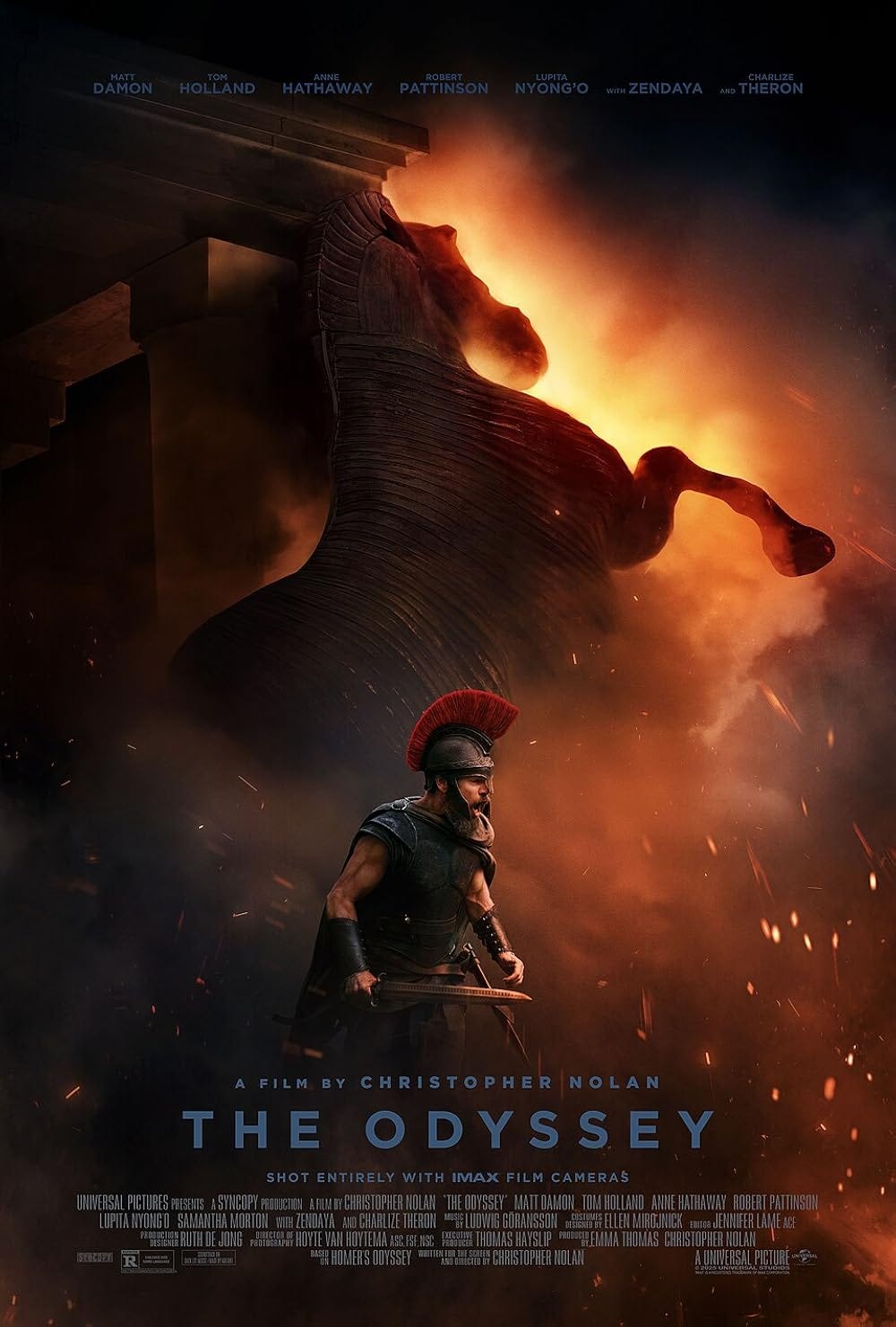
The Odyssey is a story that famously begins in media res, in the tangled midst of the story closer to its end than its beginning. And even though things, across its many narrative threads, are at their own (untenable) impasse, they teeter on the verge of decisions that will propel everything to follow. As it gets going, we realise that it is story nestled within story within story, moving fluidly between past and present, traversing the real and fantastical worlds.
What makes the sprawling episodic epic poem so charming and propulsive also makes it challenging to tame into a cohesive whole for the screen. Christopher Nolan’s adaptation isn’t immune to the unwieldy nor is it without faults, but it helps that he’s a director with a clear manifesto, with every element of his storytelling, sometimes even the characters, in service to it rather than the other way around.
In his Odyssey, this connective tissue (even if not all of it is immediately visible or clear) is xenia, the ancient Greek concept of hospitality and guest-friendship protected by Zeus. Zeus’ Law, Emily Wilson writes in the introduction to her landmark1 2017 translation, is a “complex concept, which hovers in an uneasy space between ethics and etiquette”. It is xenia that’s broken when Paris takes Helen (xenia even if you believe Helen went of her own accord or was bewitched by Aphrodite). It’s xenia that is violated by the Trojan Horse. It’s xenia that the suitors take obscene advantage of in Odysseus’s home while he is away. It’s xenia on the islands of Polyphemus, Circe, and Calypso. Telemachus practises it by welcoming every stranger and traveller as if they were the gods themselves in disguise; it is what he experiences the positive sides of when he travels to Sparta in search of news of his father.
Nolan is interested in exploring what happens when the social constructs and, dare I say it, tenets that govern a people and a larger world crumble. What does good, bad, justice, fairness, honour mean in a world of war, cruelty, violence, and lawlessness? How will we treat each other, strangers and foreigners and friends alike, in this new world? He raises questions about choice and agency within societal boundaries, and interrogates heroism. What it means to be one and at what cost, about who gets to decide who or what a hero even is. Some of its conclusions won’t come as a surprise, but for Nolan, there are, within the ruins of crumbling civilisation, crumbs of something resembling hope, and it’s hard not to store one away for ourselves.
As you can tell, this perspective, the analytical lens applied to an ancient world, is unapologetically of our current times (with the anachronistic language to accompany it, which I surprisingly barely even noticed after a short while).
Emily Wilson chose to translate the first epithet attributed to its main man—polytropos—in the poem’s opening line as complicated instead of multifaceted, or a man of many twists and turns.
“Tell me about a complicated man.”2
Despite being inspired by her translation, Odysseus here seems to eschew that specific complexity for the broodiness of a Nolan leading man. I don’t think he ever fully transcends the mould—he is too earnest an all-American hero to also be truly wily—but there are moments that build a convincing portrait of a flawed, impulsive, calculating man. Most importantly, however, he fits the story Nolan has set out to tell.
This Odysseus doesn’t trick the gods out of hubris; his defiance stems from seemingly not believing in them (as much as it is possible to be an unbeliever in his time). He suffers from guilt and PTSD, he struggles to come to terms with war and the widespread destruction he was responsible for unleashing on the Trojans in their city through dishonest means. He is repentant and wants to make amends. He worries that his loved ones won’t recognise him, that he won’t recognise them or his home, that he isn’t worthy anymore. After twenty years away, he doesn’t know what he will find. This Odysseus, the story slowly unfurls, doesn’t want to go home, the reason for which is disclosed in a monologue that is one of the movie’s best, most affecting parts—in true Nolan fashion it’s not so much a narrative twist in the final act as a fundamental piece we didn’t even realise was missing but now reveals the whole that was there all along. And yet he knows he must return and face everything, and everyone, awaiting him there, even if he doesn’t know. In the absence of the gods’ direct involvement, his odyssey then becomes equally a journey of reckoning with the consequences of the fate he has wrought upon himself, and the undeniable ripple effect of individual and communal actions—we are all, in the end, at the mercy of uncertain tides.
For, to further the modern sensibilities fuelling his adaptation, Nolan chooses to omit divine intervention. In this “time of apparent magic”, the gods of the Greek pantheon aren’t the meddling, mercurial and physical manifestations of the poem. Apart from the cheeky nod to the big guy (lightning every time his name is mentioned, usually in reference to Zeus’ Law), the gods and goddesses here are abstract presences, figments of our beliefs, and people’s relationships to faith appear to be defined by personal choice.
The one exception is Athena, who shows up intermittently, visible only to Odysseus. Though I am more and more inclined to believe that she was not the goddess herself acting as Odysseus’ conscience, but simply a manifestation of his conscience as visualised by his subconscious mind, I felt that the culmination of this narrative thread in the flashback inside Troy on the night of its sacking was too on the nose.
Which brings me to a central tension that’s present almost throughout. Nolan’s rational, grounded approach, while it mostly makes sense within the world he has established, does inevitably butt heads with the Odyssey’s multiple inseparable magical and playful elements (Cyclops! Laestrygonians! Lotus Eaters! Sirens! Witches! Nymphs! The Underworld!). The script, while it shines in some of these setpieces, doesn’t always know how to integrate the two, which is a shame, and this leads to some tonal unevenness.
But when you pare it all down, it’s really about family and home. It’s about Penelope and Telemachus, and yes, Odysseus. By anchoring itself firmly in human motivations and emotions—beyond the big ideas, it is also an exploration of one of the poem’s defining themes of nostos, of the inevitably bittersweet nature of homecoming and the grief of loss and change—and by offering empathetic glimpses into each character (beyond the suitors, of course), the movie creates enough for us to hold onto amidst the larger-than-life scale of an epic tale.
The Odyssey’s first stanza ends in, “Tell the old story for our modern times. Find the beginning.” For me, Nolan’s attempt (and it is quintessential Nolan, because why wouldn’t it be3) is an immersive, all-consuming experience achieving, for all of its failings, exactly that; largely successful in what it intended to say.4 It has also ensured that I will revisit pages of its source text sooner than later (I’m team Emily Wilson, in case it wasn’t clear) and pay another visit to Daniel Mendelsohn’s wonderful memoir, An Odyssey, about teaching the classic and his relationship with his father. For others new to this, even if the movie can be, as seems to be the case if the book sales are to be believed, a gateway to the original’s rich legacy, then a purpose has already been served.
If you’ve enjoyed today’s issue, here’s a few things you can do:
• click on the heart below to like it
• Buy me a “coffee” and support my work at https://buymeacoffee.com/anushreenande
• turn this into a conversation by leaving a comment below or dropping me a line via email, even just to say hi—I always love hearing from you 😊
• share it with friends and family who might like to read it
Stay well!
Anu
Not just for being the first by a woman into English, but I’ll do a separate post on that someday.
And what about the women, you may (correctly) ask? There’s some improvement here in Nolan’s infamous inability to write three-dimensional women—Penelope and Circe, for all the missed chances in their characterisation, are the standouts—but Calypso seems like a return to base camp.
Even casual moviegoers by now know what to expect from a Christopher Nolan movie, so why is anyone surprised and complaining about everything they wish it was instead?
There are stories I’m more fundamentally and personally connected to where I’m going to want a more “faithful” representation of the source text, so I understand where those critiques are coming from, but I’m also a strong believer of analysing the story in front of us by meeting it on its own terms and within its narrative bounds. Not to mention that, unlike other book-to-screen adaptations, this is a story that has been evolving for millennia, even before Homer wrote it down (let’s not get into whether he was real or represents a group of scribes and poets or we’ll be here all day), and myths inherently offer more room for interpretation, even if there are certain academically accepted cultural markers and consensus about core traits and themes. At the end of the day, this is a single adaptation, not a definitive one.
I relived the movie all over again while reading your article. Well done.